12 August 2006
China Chronicles - Fourth Installment
02 August 2006
China Chronicles - Third Installment
19 July 2006
China Chronicles - Second Installment
My friend had the day off and we headed to the Temple of 10,000 Buddha’s in the New Territories. The path to the temple was flanked by golden Buddha statues in different postures each representing a different aspect of the Buddha. My favorite was a cheery fellow who sat with a serene yet mischievous look on his face while calmly opening his sternum to reveal a meditating Buddha within. His soul was enlightened and strong within him and he had no trouble sharing his wisdom with others. Yet he bared his soul in a slightly shocking manner demanding notice from even the coldest hearts, and the mischievous look on his face made it clear that he knew exactly what he was doing.
The temple itself was at the top of the path and its interior was a wonder with row upon row of tiny Buddha figurines covering the walls from floor to ceiling. Conical pillars housed more tiny Buddhas each individually lit with a tiny fairy light and on the main alter three large Buddha statues and a replica of the temple’s founding monk completed the picture. Despite its name the monastery contains more than 10,000 Buddhas and the main temple alone houses more than 12,000. In the main courtyard older Chinese women moved from alter to alter elegantly bowing with incense sticks and worshipping as the smoke curled into the still air. We tried to follow their lead, but we discovered that worship takes practice as we burned ourselves on the incense pots and dropped hot ash onto our sandaled feet. We provided locals with some entertainment and I think the Gods appreciated our trying - especially Kwan Yin who is the Goddess of Mercy and self compassion.
Day 4: Hong Kong Island Tour and the Fish, Flower and Bird Markets of Mongkok
We started the day with Dim Sum and I got to try deep fried chicken feet (quite tasty). Then we took a ferry to Aberdeen, a harbor on the southern shore of Hong Kong Island where we marveled at row upon row of traditional fishing boats and sampans. From Aberdeen we hopped on a minibus to Kennedy Town and my friend showed me the huge condominium towers where nearly all of her students live. In her kindergarten they don’t ask the kids which street they live on but rather which floor! From the upper class condos we walked into a poorer region of town where the buildings were tightly packed and blackened by acid rain, and the windows contained rusting AC units that dribbled condensation onto the street below. A huge highway flyover passed between the buildings, so close to the windows that residents could spit on passing cars!
From Kennedy Town we grabbed a double-decker tram and rumbled toWan Chai where we wandered through a sea food market. The Cantonese take fresh food very seriously and we watched as live fish were removed from buckets, butchered on spot and laid out on display with their hearts still beating! That’s fresh. Although many Westerners find this practice cruel, I feel that keeping meat products alive as long as possible is a practical way to stave off food poisoning in regions where refrigeration is scare. After all, the packaged and frozen meat we eat is also butchered; we are simply removed from the reality of the kill.
From Wan Chai we headed to Victoria Park where thousands of the city’s amahs (live in maids and nannies) were camped out for a festival. Hong Kong has over 250,000 foreign domestic workers (mostly women amahs) and on Sundays they take to the streets, parks and sidewalks to talk, laugh and enjoy their day off. It's really something to see, and for me it almost seemed like social action. It is as if hundreds of thousands of workers are saying "Remember us. We are a huge presence. We are the ones who run the houses and raise the children here".
We ended the day back in Mongkok where we headed to the fish market (goldfish in baggies everywhere), flower market and Yuen Po Bird Garden. This bird market has been around for years and is a testimony to the centuries old Chinese tradition of keeping songbirds as pets. But times do change, and today the market is posted with signs that read: The Agriculture, Fisheries and Conservation Department regularly collects specimens at the Yuen Po Bird Garden, Mongkok for testing. To date, all specimens have given negative test results for the H5N1 Influenza virus.
10 July 2006
China Chronicles - First Installment
14 May 2006
A Bridge between Canada and the Netherlands
My husband and I decided to move to the Netherlands in part because we felt that the Dutch were more open minded and liberal than North Americans and we wanted to learn from Dutch society. My husband is from Panama, and a year-long battle with immigration for a Canadian visitor visa taught us that intolerance is alive and well there - at least at the bureaucratic level. Once the visa was issued, however, and we finally arrived for our visit, my husband fit right in. The residents of Toronto did not bat an eyelid at one more Latin American, and even when he spent a month in a small town of about 500 in southern Ontario, he didn’t feel any racial tension. The story has been very different in the Netherlands. There was no battle for a visa, but there has been racial tension. One memorable night, my husband was followed by a group of white males who hurled insults at him (most of which he didn’t understand) calling him a “kebab” and an “immigrant”. The incident did not escalate to violence, but it was chilling nonetheless.
The “immigration/integration situation” in the Netherlands entered Canadian society at the national level over a year ago in an article published in the national newspaper The Globe and Mail. The article was entitled “It just doesn’t feel like Holland anymore” and discussed a recent exodus of Dutch people to Canada - Dutch who are troubled by the ways in which immigration has changed their nation. Now there is irony for you. We moved to the Netherlands because of its reputation for tolerance and now many Dutch are moving to Canada in search of exactly the same thing! But is there a difference between tolerance in the Netherlands and tolerance in Canada? The Globe and Mail article stated that “the ethnic cleansing and mass migration of the two world wars left many European countries with one dominant ethnic group, so the presence of large numbers of visibly different people has alarmed and alienated many residents.” But the Dutch are traders who have come into contact with “buitenlanders” (foreigners) for centuries. I suppose the answer lies in the distinction between foreigners as trading partners and foreigners as permanent members of society. One Dutch emigrant interviewed in the Globe article stated that problems in the Netherlands stem from that fact that “Holland has let too many people in without attention to their ability to fit into Dutch society”. The citizens of his town now come in a variety of hues and hold a variety of beliefs, and to him it just doesn’t feel like home any more. I wonder how this man will feel when he arrives in Vancouver (multicultural to say the least and his chosen point of entry into Canada) and sees that several of the customs officers wear turbans and headscarves.
Personally, I have never had a problem with immigrants keeping their traditions. In fact, I find the ethnic alcoves of big cities - the China towns, Greek towns, Little Italy’s and Little India’s - an integral part of modern living. I thoroughly enjoy it when immigrants become active members of their new country without leaving their traditions from home behind. Many Dutch people agree. My husband and I have many Dutch friends who are embarrassed by their nation’s new found intolerance. Furthermore, many Dutch emigrants are leaving not because of the immigrants, but because of the Dutch reaction to them, which has “turned their country men into angry intolerant nationalists”. I sympathize. It’s shattering to discover that your country and your people are not as tolerant as you once believed. Before experiencing a year-long battle over permission to merely visit Canada, I too thought my country was a vision of tolerance. Still, Canada may have a few advantages (once the visas have been issued). The emigrants leaving the Netherlands because of the Dutch response to immigration feel that “Canada is a place where the tension between immigrants and non-immigrants does not exist, because that distinction does not exist”. It is true that in Canada, nearly everyone is an immigrant, so the distinction between “us and them” is blurred and integration becomes less of an issue. In my experience (and I can only speak for myself) there is a very distinct line between the Dutch and the foreigners in the Netherlands. This is not to say that there is no mixing, everyone works together and collaborations abound; however, in social situations there is a tangible “us and them” feeling. It is uncomfortable, it makes me feel guilty for not integrating more, and it is something I haven’t felt anywhere else.
I hope that Dutch immigrants seeking tolerance in Canada will find what they are looking for. Tolerance in the Americas is certainly not perfect. A look at the news in Canada and the US will show mass protests over the deportation of illegals, much like the news in the Netherlands follows the struggles of Taïda Pasic and Saba Rawi. Like the Netherlands, Canada is known throughout the world as a tolerant nation and I hope that despite it’s own debates, it can live up to that reputation.,
19 February 2006
Barcelona beckons: A paradise of art and culture even in the winter
Sculpture at Montserrat
Living in northern Europe gives me the distinct advantage of having many of the western world’s cultural hotspots a mere stones throw away (by Canadian standards at least) and this past month I decided it was time to visit Spain. After all, the Spanish have given us the novel, the guitar, flamenco, Picasso, gazpacho and in
I started my visit like any other tourist, strolling down Las Ramblas, the city’s most famous street. Even on an overcast Sunday in January, the spirit of this street could not be stifled. In fact, I enjoyed Las Ramblas far more on Sunday. After all, one can find stores anywhere, but when those retail outlets close, the unique styles and spirits of
From Las Ramblas, I made my way to the Barri Gòtic, or the Gothic Quarter located at the very heart of
But
A sight that is not to be missed is the unbelievable Temple Expiatori de la Sagrada Família (
The church’s most striking features are its eight spindle-shaped towers. Many visitors find the architecture overpowering and some find it down right ugly, but I like Gaudí’s style. His Nativity façade, built before construction was interrupted by the Spanish Civil War in 1935, is exceptionally ornate and clearly shows the artist’s devotion to his work. In contrast, the Passion façade was designed by Joseph Subirachs and is especially striking (and controversial) for its understated and tormented characters portraying the crucifixion of Christ. The interior of the church is equally stunning, though it resembles and in fact is, a construction zone. In the main vestibule, columns modeled after trees reach skyward creating the distinct feeling that one is in a forest – natures own cathedral.
I was so inspired by Gaudí‘s work that I spent the better part of the following day in his Park Güell on the hill of El Carmel in the north of the city. Built from 1900 to 1914 the park was originally meant as a suburb for the rich, but it is now opened to the public. Gaudí‘s surreal style can be seen throughout the park in enormous wavy benches, lava-like stalactites, tree-like supports juxtaposed with stark Doric columns, all lavishly decorated with mosaics of broken ceramic fragments, a Catalan technique. And even more than in la Sagarada Família, ParkGüell is in tune with nature. Gaudí wound his paths and grottos around the hill’s natural slopes and cliffs giving the park a calm and peaceful feeling – even when full of tourists.
Of course no visit to
In fact despite its great (and well deserved) popularity with tourists,
20 December 2005
Belgium: Well worth stopping for a visit
I began in Brussels, a true cultural hub and the capital of both the Flemish and French parts of Belgium, as well as the capital of the European Union. Brussels is a cosmopolitan city, with liveliness and appeal intimately related to its role as a crossroads for Europe. I spent an afternoon and evening wandering around this city of about 1.3 million, and finding that the city’s vibrancy and classic style reminded me of Paris. In the larger city squares I was delighted by fabulous antique carousels sporting giant Pterodactyls, World War II planes and Art Noveau insects instead of ponies for revelers to ride. I was charmed. My stomach was charmed too since hot chocolate and spiced wine were on offer everywhere as were delicious Belgium waffles and scrumptious Belgium chocolate truffles. It was a gastronomic delight!
The name Brussels comes from the old Dutch Bruocsella, Brucsella or Broekzele, meaning "marsh (bruoc, bruc or broek) home (sella or zele)", thus "home in the marsh". I imagine that the name symbolises the very beginings of the area. However, the official founding of Brussels is usually thought of as 979, two years after the Duke of Lorraine moved to Saint Gery Island (then encompassed by the Senne River) in what is now Brussels. Around the same time two other important Flemish cities, Ghent and Bruges were flourishing and I visited those two cities next.
I spent only a morning in Ghent, but even in that short time I was impressed by the cities medival buildings including the belfry and the towers of the Cathedral and Sint-Niklaas Church. These buildings made up what could be called the “Manhattan of the Middle Ages”. The region of Ghent was inhabited in Celtic times and the name comes from the Celtic word “ganda” which means “converging” (for example, of two rivers). When the Franks invaded the Roman territories from the end of the 4th century and into the 5th century they brought their language with them and Ghent became a region where Celtic and Latin were replaced by ancient Dutch. Outside Italy, Ghent was the biggest city in Europe (after Paris) until the 13th century; bigger than London, Cologne or Moscow.
From Ghent I headed to Bruges a city with a very long history. Bruges began more than 2000 years ago as a Gallo-Roman settlement, its name originating from the Old Norse "Bryggja" which means “landing stage”. Bruges has a long tradition of international port activity and by the eleventh century, Bruges had expanded to become a commercial centre for Europe. The the city grew and prospered until 1500, when the natural link between Bruges and the sea silted up, and the port of Antwerp became a rival. Bruges slept through the industrial revolution and by the middle of the 19th century, it had become the poorest town in Flanders. However, the lack of industrialization became a blessing in disguise, as the untouched medieval city center was later recognized as an open-air museum, and has been a UNESCO World Heritage Site since 2000. When I visited in the dead of winter, the ancient buildings glowed against a foreboding sky that threatened snow and added to the magical feeling of begin transported back in time.
I ended my visit to Belgium in Antwerp. As I moved from Brussels to Ghent and Bruges and then finally to Antwerp the change in culture from French to Flemish was striking. In fact, Antwerpen even looked and felt a little like the Dutch cities we know from the Netherlands. However, many aspects of the city were unique and the visit was well worth it.
According to folklore, the city of Antwerp got its name from a legend involving a mythical giant called Antigoon that lived near the river Scheldt. This giant exacted a toll from passers-by who wished to navigate the river. On refusal, the giant often severed one of their hands and threw them into the river. Eventually, the giant was slain by a young hero named Brabo, who cut off the giant's hand and threw it into the river. Hence the name Antwerpen from Flemish Hand werpen (hand-throwing). This legend explains the many hand shaped sculptures and forms throughout the city.
The city of Antwerp gained economic importance after the decay of Bruges and even today Antwerp remains Europe’s third, and the world’s fifth largest port. In addition to its trading heritage, Antwerp is famous for its diamonds. To me however, it has a very strange way of displaying them. In a long street adjacent to the central train station I found shop after shop literally “stuffed” with diamond jewelry. The displays looked like something from a pawn shop and yet there are real diamonds there among florescent pink signs screaming “50% off”. I was amazed and even managed a few photos before my camera and I were chased away. Photos of the displays it seems are “verboden” (forbidden). It was however a “classic Me” moment to be chased away from a diamond store.
Belgium is small and often forgotten by travellers making a whirlwind tour through Europe. But if one takes the time to stop and look around it is easy to understand why this countries inhabitants consider it the best kept secret in Europe. Belgium is Europe in a nutshell, multicultural and multilingual.
01 November 2005
Full Circle
Life over the past few months has been busy – very busy. Between running a long-term experiment, commuting back and forth across a country (albeit a small one), and attending a conference in
As I’ve mentioned before, I am a BBC World Service addict. One of my favourite programs is “From our own Correspondent”, in which journalists, who must normally report objectively, give their personal feelings and experiences about a story that they are covering. Recently, two stories have really hit home for me. The first is from Nick Thorpe who offered comments about bird flu, and the second is from Chris Morris reporting on
* * *
“Don’t demonize the wild birds” pleads Romanian ornithologist Eugen Petrescu in the BBC report, “Bird flu began among poultry in Southeast Asia almost certainly because of the way that people treat domesticated birds - cramped together in small cages. They infected the wild birds, which are now bringing the virus to
Full circle indeed! Once I lifted my head from the sand I realized that almost everyone is paranoid about bird flu, and here I am working day in and day out with highly migratory birds caught from the wild. And to take things an ironic step further, I am working on their immune function.
The other day someone asked me what our research facility’s decontamination protocol was. Decontamination? I hadn’t even thought about it. Of course we are being more careful and visitor access to the aviaries has been restricted, but decontamination? I suppose the birds would be killed if there were an outbreak. Culling seems to be the solution everywhere else.
But what is the situation in infected areas in the wild? From Nick Thorpe’s BBC report it seems like the infected
Eugen Petrescu hopes that scientists will try to engineer a vaccine for birds and not put all their effort into a vaccine for humans. This isn’t a bad idea. We humans don’t usually consider any perspective but our own. We worry about pandemics, we struggle to create human vaccines, and then we argue about who should have access to them. Why not at least try to vaccinate the chickens too and stop the transmission there? Lower the transmission among the birds and maybe save a few wild populations too. After all, the birds didn’t create bird flu - we are the most likely culprits.
We often forget that we are also animals, and that our own numbers are out of control. When a species overshoots its carrying capacity several factors come into play. There is normally a shortage of resources, be they food, fresh water or oil, and there is competition for those resources (i.e. wars). There is also disease. No one wants to suffer and no one wants to lose their livelihood, be it via the culling of enormous chicken farms, or the quiet loss of a few subsistence hens that mingled with wild birds in the backyard pond. And if bird flu or any other pandemic disease becomes a human to human pathogen no one will want to lose loved ones or their own lives. But if or when it comes full circle, we shouldn’t be surprised.
* * *
“Can values have borders, can we build barriers around them?” Chris Morris asks.
“I suppose people have tried to do just that throughout European history. Hadrian built his Wall, and many centuries later Stalin his Iron Curtain. The one to keep people out, the other to keep them in.”
“But it has never really been that simple …”
Just as the invasion of bird flu is a threat to
My own background is rather diverse. My father is Swiss (a European but not in terms of the European Union). My mother is from
Confused?
So are many others and I am often asked, “What nationality do you identify with?”
I always answer Canadian. After all, I grew up there and aside from a few conflicts over (ironically) immigration laws, I have always felt fairly comfortable being Canadian. At times, I also feel Panamanian. Although I have spent much less time there, I married a Panamanian and from the beginning
“But have you been to
Despite holding a Swiss passport, I have never felt very Swiss.
“Do you feel Dutch after living nearly two years in the
I do not. In fact I don’t feel European at all.
But how do the Europeans feel?
It seems to me that
“It is rather different on the other side of the
It’s true – at least once you get past immigration. And the same is true for
“There are Japanese Americans, Lithuanian Americans, Arab Americans and so on.” Chris continues, “In
Growing up, I had friends of every shade and background. But I never even noticed. They were just my friends - simple. Of course, I can only speak for myself growing up in a large and multicultural city, perhaps, others had different experiences. But for me friends were friends, neighbors were neighbors – and yes there was a sense of belonging and acceptance for everyone, something that I have yet to feel in
For me this is also a bit of a story about coming full circle. My husband and I came here as an admittedly idealistic pair who longed to live in what we believed to be a mature
* * *
To sign off I must make one final comment …
It seems that in keeping my head in the sand I am decidedly human. To give a short example, ten minutes ago I heard that tropical storm Beta has been upgraded to a hurricane. Beta! This means that this year we have had so many tropical storms that we’ve run out of names! And yet in 1985 gas guzzling SUVs accounted for only 2 percent of new vehicle sales and today SUVs account for one in four new vehicles sold*. I scratch my sandy head …
* Note the stats are representative of the
22 August 2005
Nordens Ark, Aby Fiord, Sweden
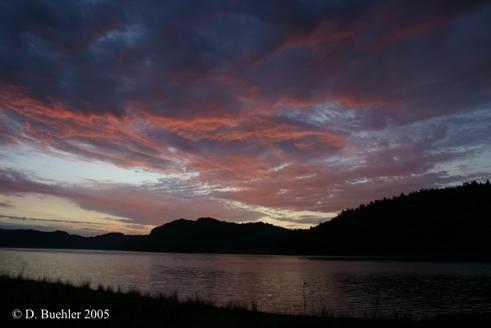
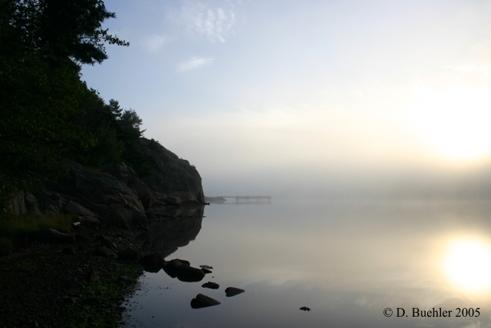
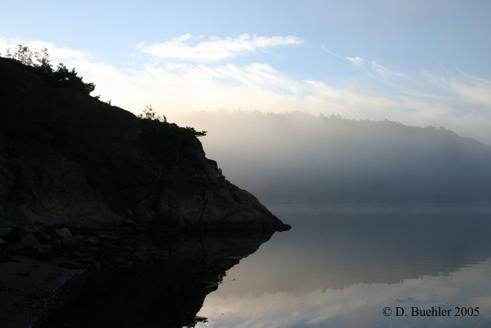
This month I've decided that pictures really are worth thousands of words. So rather than trying to describe the beauty of the area around the Aby Fiord, about one and a half hours north of Gothenburg, Sweden. I'll let you see for yourselves. In the following post pictures 1 - 6 show a misty sunrise over the Aby Fiord, and pictures 7 - 9 show sunset over the rocky shores near the fishing village of Smogen.
Aby Fiord
In the damp morning air you are shrouded,
hidden beneath a white gauzy veil.
Then as if awakening,
warmth and light enter,
and you reveal yourself,
one miracle at a time.